Formation of life’s building blocks recreated in lab

8 December 2014

Formation of life’s building blocks recreated in lab

By Colin Barras

WhereItAllCameFromTalk about making an impact. One of the meteorites that slammed into the planet early in its history could have kick-started life: the collision may have generated all four of the bases in RNA. Life appeared on Earth around 4 billion years ago, about the same time that the planet was experiencing a beating from large meteorites – an event called the Late Heavy Bombardment. As far as Svatopluk Civiš at the Academy of Sciences of the Czech Republic in Prague and his colleagues are concerned, that’s no coincidence.

They simulated a meteorite impact on early Earth by firing a high-power laser at samples of formamide a liquid that would have existed on our primordial planet. The sample temperatures soared to 4200 °C, generating X-rays and extreme ultraviolet radiation that reacted with the formamide to create chemical radicals. These radicals, in turn, reacted with hydrogen and the remaining formamide to generate 2,3-diaminomaleonitrile – DAMN for short – which is a chemical precursor to the nucleobases. When Civiš and his colleagues examined the end products of their reaction, they found all four RNA bases: adenine, guanine, cytosine and uracil – three of which are also found in DNA.

The work “nicely correlates the Late Heavy Bombardment and the energy that it delivered to Earth with the formation of RNA and DNA nucleobases from formamide”, says Steven Benner at theFoundation For Applied Molecular Evolution in Gainesville, Florida.


What an impact

It was two Italian researchers – Raffaele Saladino at the University of Tuscia and Ernesto Di Mauro at the Sapienza University of Rome – who first suggested, in 2001, that formamide played an important role in the origin of life. It forms when hydrogen cyanide, which was present in Earth’s early atmosphere, reacts with water. Although Saladino and Di Mauro have shown other ways that formamide can generate the four nucleobases, Di Mauro says “this is the first time that solid theoretical treatment and experimental data are presented together”.

He adds that even more biologically important molecules can be generated if these experiments consider the role that various minerals inside the meteorites might have played as catalysts – something his latest, still unpublished work has explored. “The obtained products are astonishingly rich and variegated,” Di Mauro says. Saladino and Di Mauro suggested formamide would have concentrated in warm lagoons on our young planet – particularly because formamide has a higher boiling point than water, so would concentrate as water evaporated. Donald Lowe, a geologist at Stanford University who studies the Late Heavy Bombardment, says such environments did exist on early Earth – despite the disruption caused by the impacts.


Living the dry life

“Although the impact frequency may have been 10s or 100s of times greater than it is today, your chance of experiencing a large impact at the height of the LHB would have been small,” says Lowe. “Lagoons or, in more general terms, shallow-water protected settings, are likely to have been well developed on the early Earth.”

The work still doesn’t quite answer the question of how the RNA bases came together with other complex molecules to form RNA, though. “This is what we are working on right now,” says Civiš. For instance, they hope to generate carbohydrates through similar laser experiments. But if huge impact events were critical for the generation of life’s key molecules, water was apparently not.

Saladino and Di Mauro’s work on formamide suggested that the first, small RNA molecules were most likely to come together in a relatively water-free environment – like a formamide-rich lagoon.

Benner points out that some geologists think early Earth had too much water to allow these environments to exist, which last year led him to suggest that these formamide reactions may actually have occurred on the much drier early Mars, before life later rode through space on Martian meteorites to reach Earth.

The idea is compatible with Civiš and his colleagues’ work emphasising the role of impact events. “The current view is that all of the inner planets experienced the Late Heavy Bombardment,” says Benner.


Journal reference: PNAS, DOI: 10.1073/pnas.1412072111

From <https://www.newscientist.com/article/dn26672-formation-of-lifes-building-blocks-recreated-in-lab/>
NASA Scientists Cook Up Building Blocks of Life in Lab

By Nola Taylor Redd, Space.com Contributor | April 9, 2015 10:40am ET

NASA_Ames_Scientists

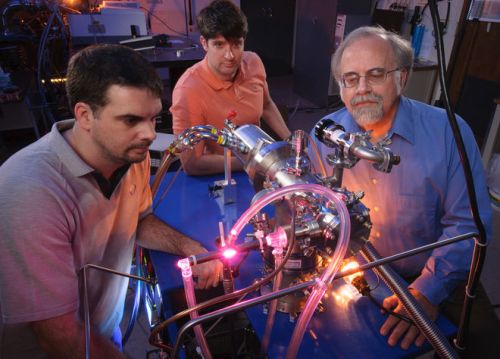
Left to right: NASA Ames scientists Michael Nuevo, Christopher Materese and Scott Sandford reproduced key components of RNA and DNA in a laboratory.

Credit: NASA/Dominic Hart

Many of the chemical ingredients necessary for life as we know it were available on the early Earth, and should be present on exoplanets as well, new research suggests.

Researchers at NASA’s Ames Research Center in California generated three key components of RNA (ribonucleic acid) and DNA (deoxyribonucleic acid) in the lab, by exposing commonly occurring ring-shaped molecules of carbon and nitrogen to radiation under spacelike conditions.

“Nobody really understands how life got started on Earth,” Scott Sandford, a space science researcher at Ames, said in a statement. “Our experiments suggest that once the Earth formed, many of the building blocks of life were likely present from the beginning. Since we are simulating universal astrophysical conditions, the same is likely wherever planets are formed.”

Sandford and his colleagues worked with pyrimidine, a ring-shaped molecule often found in meteorites. The rings hold carbon atoms, but the presence of nitrogen makes pyrimidine less stable than other carbon-rich compounds, researchers said. As a result, pyrimidine is easily destroyed by radiation, which is prevalent in interstellar space.

“We wanted to test whether pyrimidine can survive in space, and whether it can undergo reactions that turn it into a more complicated organic species,” Sandford said in the same statement.

Pyrimidine

Pyrimidine is a ring-shaped molecule composed of carbon and nitrogen. It serves as the central strucutre for uracil, cytosine, and thymine, all key components of RNA and DNA.

Credit: NASA

Pyrimidine should be vulnerable to destruction when traveling through the universe as a gas. But the researchers reasoned that some molecules might be able to survive if they find their way into interstellar clouds of dust and gas.

Such clouds could serve as a shield, absorbing much of the radiation on the outer edges and keeping it from reaching the interior. Safe inside the clouds, the pyrimidine molecules would freeze onto dust grains, which might allow them to survive any radiation to which they would later be exposed.

To test their idea, the scientists exposed an ice sample containing pyrimidine to ultraviolet radiation in a vacuum at temperatures as low as minus 440 degrees Fahrenheit (minus 262 degrees Celsius) —conditions similar to those experienced in interstellar space.

When frozen in ice consisting mainly of water, but also containing ammonia, methanol or methane, the pyrimidine was much less vulnerable to radiation than it would be as a free-floating gas. Instead of destroying the molecules, the radiation transformed it into new species, including uracil, cytosine and thymine — three of the “nucleobases” that make up DNA and RNA.

“We are trying to address the mechanisms in space that are forming these molecules,” Ames researcher Christopher Materese said. “Considering what we produced in the laboratory, the chemistry of ice exposed to ultraviolet radiation may be an important linking step between what goes on in space and what fell to Earth early in its development.”

Although scientists know that pyrimidine is found in meteorites, they are still uncertain about its ultimate origins. Like the more stable, carbon-rich polycyclic aromatic hydrocarbons (PAHs), considered as potential material to kick-start life, pyrimidine may be produced by the dying breaths of red-giant stars or in clouds of interstellar gas and dust, researchers said.

Homo Or Hetero?

Homo Or Hetero? The Neurobiological Dimension Of Sexual Orientation

Original Publication: Tuesday 31 May 2011

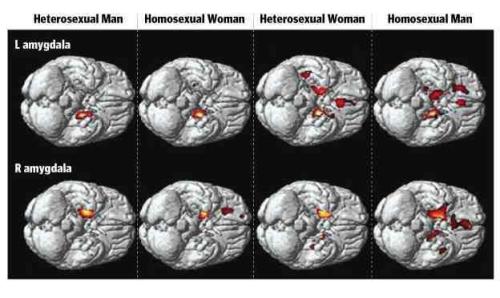
“Sexual orientation is not a matter of choice, it is primarily neurobiological at birth”, Dr. Jerome Goldstein, Director of the San Francisco Clinical Research Center (USA) stressed today at the 21st Meeting of the European Neurological Society (ENS) in Lisbon. “There are undeniable links. We want to make them visible to the eye”. At the congress he showed how the brains of people of different sexual orientations – gay, straight, bisexual – work in different ways, applying volumetric Magnetic Resonance Imaging (MRI), functional fMRI scanning, and PET scanning.

There have been several reports of twin studies indicating the probable genetic link of sexual orientation. Dr. Goldstein has begun accumulating a database of identical twins, whose sexual orientation will be further evaluated by MRI, fMRI scanning, and PET scanning.

Origin of sexual orientation: current data

“Using volumetric studies, there have been findings of significant cerebral amygdala size differences between homosexual and heterosexual subjects. Sex dimorphic connections were found among homosexual participants in these studies,” Dr. Goldstein noted. He provided current data regarding homosexuality showing differences and/or similarities, between the brains of homosexuals and heterosexuals.

Similarities between the brains of gay men and heterosexual women

“Some of the most striking results were delivered recently by Dr. Ivanka Savic-Berglund and Dr. Per Lindström of the Karolinska Institute, Stockholm, Sweden”, Dr. Goldstein reported. The Swedish experts performed volumetric studies, fMRI and PET measurements of cerebral blood flow. Using volumetric studies, they found significant cerebral and amygdala size differences between homosexual and heterosexual subjects. Thus the brains of homosexual men resemble those of heterosexual women and those of homosexual women resemble to heterosexual men. The plan for continued studies is to expand the number of subjects evaluated, thus verifying the validity of data already available.

Pheromonal studies also have added to the scientific knowledge of sexuality, according to Dr. Goldstein. “Sex-atypical connections were found among homosexual participants. Amygdala connectivity differences were found to be statistically significant and provided evidence towards sexual dimorphism between heterosexual and homosexual subjects. ”

“We must continue to bring forward data that show the differences or similarities between the brains of homosexuals, heterosexuals, bisexuals, and trans gender persons. Clearly the basis of sexual orientation is in the brain and differences in brain structure and function and the province of neurology”, Dr. Goldstein added. “Neuroscience has much to offer in the area of understanding the origins of all variations of sexual orientation. The neurobiology of sexual orientation and the gay brain, matched with other hormonal, genetic, and structural studies, has far-reaching consequences beyond sexual orientation.” Treatment variations are already emerging as a result of recognition of sexual orientation differences and the advent of gender specific medicine.

Source: ENS Abstract The neurobiology of sexual orientation – total medical evidence presentation

Source:
ENS 2011

Source Article: http://www.medicalnewstoday.com/releases/226963.php


Rosetta’s comet contains ingredients for life

27 May 2016

Ingredients regarded as crucial for the origin of life on Earth have been discovered at the comet that ESA’s Rosetta spacecraft has been probing for almost two years.

They include the amino acid glycine, which is commonly found in proteins, and phosphorus, a key component of DNA and cell membranes.

Scientists have long debated the important possibility that water and organic molecules were brought by asteroids and comets to the young Earth after it cooled following its formation, providing some of the key building blocks for the emergence of life.

While some comets and asteroids are already known to have water with a composition like that of Earth’s oceans, Rosetta found a significant difference at its comet – fueling the debate on their role in the origin of Earth’s water.

But new results reveal that comets nevertheless had the potential to deliver ingredients critical to establish life as we know it.

Rosetta’s comet contains ingredients for life

Amino acids are biologically important organic compounds containing carbon, oxygen, hydrogen and nitrogen, and form the basis of proteins.

Hints of the simplest amino acid, glycine, were found in samples returned to Earth in 2006 from Comet Wild-2 by NASA’s Stardust mission. However, possible terrestrial contamination of the dust samples made the analysis extremely difficult.

Now, Rosetta has made direct, repeated detection of glycine in the fuzzy atmosphere or ‘coma’ of its comet.

“This is the first unambiguous detection of glycine at a comet,” says Kathrin Altwegg, principal investigator of the ROSINA instrument that made the measurements, and lead author of the paper published in Science Advances today.

“At the same time, we also detected certain other organic molecules that can be precursors to glycine, hinting at the possible ways in which it may have formed.”

The measurements were made before the comet reached its closest point to the Sun – perihelion – in August 2015 in its 6.5 year orbit.

The first detection was made in October 2014 while Rosetta was just 10 km from the comet. The next occasion was during a flyby in March 2015, when it was 30–15 km from the nucleus.

Glycine was also seen on other occasions associated with outbursts from the comet in the month leading up to perihelion, when Rosetta was more than 200 km from the nucleus but surrounded by a lot of dust.

“We see a strong link between glycine and dust, suggesting that it is probably released perhaps with other volatiles from the icy mantles of the dust grains once they have warmed up in the coma,” says Kathrin.

Glycine turns into gas only when it reaches temperatures just below 150°C, meaning that usually little is released from the comet’s surface or subsurface because of the low temperatures. This accounts for the fact that Rosetta does not always detect it.

“Glycine is the only amino acid that is known to be able to form without liquid water, and the fact we see it with the precursor molecules and dust suggests it is formed within interstellar icy dust grains or by the ultraviolet irradiation of ice, before becoming bound up and conserved in the comet for billions of years,” adds Kathrin.

Another exciting detection made by Rosetta and described in the paper is of phosphorus, a key element in all known living organisms. For example, it is found in the structural framework of DNA and in cell membranes, and it is used in transporting chemical energy within cells for metabolism.

“There is still a lot of uncertainty regarding the chemistry on early Earth and there is of course a huge evolutionary gap to fill between the delivery of these ingredients via cometary impacts and life taking hold,” says co-author Hervé Cottin.

“But the important point is that comets have not really changed in 4.5 billion years: they grant us direct access to some of the ingredients that likely ended up in the prebiotic soup that eventually resulted in the origin of life on Earth.”

“The multitude of organic molecules already identified by Rosetta, now joined by the exciting confirmation of fundamental ingredients like glycine and phosphorous, confirms our idea that comets have the potential to deliver key molecules for prebiotic chemistry,” says Matt Taylor, ESA’s Rosetta project scientist.

“Demonstrating that comets are reservoirs of primitive material in the Solar System and vessels that could have transported these vital ingredients to Earth, is one of the key goals of the Rosetta mission, and we are delighted with this result.”

Notes for Editors

“Prebiotic chemicals – amino acid and phosphorus – in the coma of comet 67P/Churyumov–Gerasimenko”, by K. Altwegg et al is published in the journal Science Advances.

Original article: http://www.esa.int/Our_Activities/Space_Science/Rosetta/Rosetta_s_comet_contains_ingredients_for_life

Homosexuality Facts

Couple Holding Hands at Sea Sunset

I am amazed that in the year 2016 people still have an issue with same-sex couples having loving and caring lives with each other. If you don’t know yet, I am a gay man and met my partner when I was in high school. We dated. We went on vacations together. We had sex. Lots and lots of intimate sex. We caught colds, we suffered from accidental injuries. We also sat together and talked about our future.

In other words, we behaved like millions of other couples; Millions of Straight couples. The only difference is we are of the same sex. We even had arguments and disagreements. We’ve cried together over the loss of friends and family. We’ve apologized to each other when we did or said something stupid.

The difference between Joe and I and millions of straight people is that we’ve been together for 30 years as of September 8, 2016. We are not the only same-sex couple to achieve this, we have over two dozen friends that have been together longer than we have.

So what is the difference in a homosexual relationship verses a heterosexual relationship?

I’m waiting…….

Yes, we are the same sex. What else?

I’m waiting…….

You’ve got it. Religion is the difference.

So why do I have this Page on my site? I’m not here to push my life on you, because I really don’t care how you and your partner, spouse or significant other spend your time together in the bedroom or otherwise. So why do religious people dwell so much time on gay sex?

I guess my biggest question is why religious people have to lie, make up stories and deny all of the science that proves them wrong. So that is that this page is about, the science behind homosexuality.