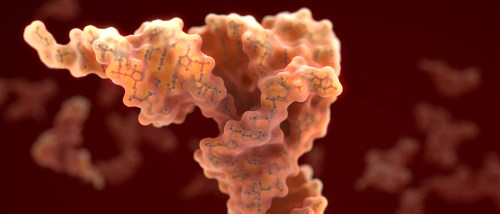
Scientists Close to Uncovering RNA Mystery

Moving Backward to Go Forward

DNA, RNA, and protein: these have been the premier scientific buzzwords in our lives since we picked up our first science textbooks in elementary school. However, there was always one thing that the science textbook never really got around to explaining: what came first the chicken or the egg? Or in our case, RNA or protein?

Scientists at The Scripps Research Institute (TSRI) have taken steps to answer the long-standing question to verify the validity of the RNA world hypothesis. The Museum of Science explains that according to the RNA World Hypothesis, “earlier forms of life may have relied solely on RNA to store genetic information and to catalyze chemical reactions. Later life evolved to use DNA and proteins due to RNA’s relative instability and poorer catalytic properties, and gradually, ribozymes became increasingly phased out.”

In short, to test this, the team has decided to build their own biological time machine to take them back 4 billion years—all by synthesizing a primordial RNA-based enzyme, a ribozyme, that has never been seen before.

The team of scientist sought to verify the two major tenets of the RNA world hypothesis:

  1. The ribozyme must be able to replicate RNA.
  2. The ribozyme must be able to transcribe RNA.

Here is a brief video describing both replication and transcription from a DNA perspective:

A Primordial Hunger Games

The scientists employed natural selection in their process to uncover evidence for the RNA world hypothesis. Building upon decades of research, the researchers made over 100 trillion variants of the class I RNA polymerase ribozyme, a molecule that theoretically could replicate and transcribe RNA.

After twenty-four rounds of experiments, the TSRI team stumbled upon polymerase ribozyme 24-3, which was able to replicate and transcribe RNA better than the team had hoped. With the new molecule synthesizing RNA molecules at a rate that is one hundred times quicker than the original start molecule, and replicating at a rate deemed as exponential replication, with forty thousand copies produced in just 24 hours.

The scientists believe that “a  polymerase ribozyme that achieves exponential amplification of itself will meet the criteria for being alive.” Providing support for the RNA world hypothesis.

Now that’s one for both history and science textbooks.

The article was published in the Proceedings of the National Academy of Sciences
NASA Scientists Cook Up Building Blocks of Life in Lab

By Nola Taylor Redd, Space.com Contributor | April 9, 2015 10:40am ET

NASA_Ames_Scientists

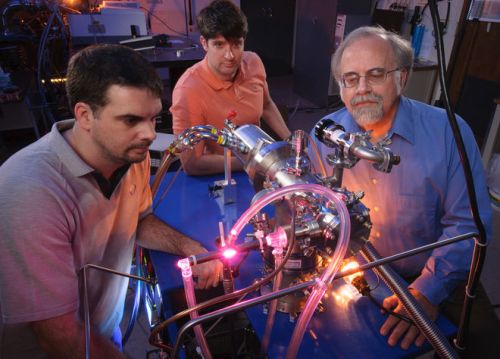
Left to right: NASA Ames scientists Michael Nuevo, Christopher Materese and Scott Sandford reproduced key components of RNA and DNA in a laboratory.

Credit: NASA/Dominic Hart

Many of the chemical ingredients necessary for life as we know it were available on the early Earth, and should be present on exoplanets as well, new research suggests.

Researchers at NASA’s Ames Research Center in California generated three key components of RNA (ribonucleic acid) and DNA (deoxyribonucleic acid) in the lab, by exposing commonly occurring ring-shaped molecules of carbon and nitrogen to radiation under spacelike conditions.

“Nobody really understands how life got started on Earth,” Scott Sandford, a space science researcher at Ames, said in a statement. “Our experiments suggest that once the Earth formed, many of the building blocks of life were likely present from the beginning. Since we are simulating universal astrophysical conditions, the same is likely wherever planets are formed.”

Sandford and his colleagues worked with pyrimidine, a ring-shaped molecule often found in meteorites. The rings hold carbon atoms, but the presence of nitrogen makes pyrimidine less stable than other carbon-rich compounds, researchers said. As a result, pyrimidine is easily destroyed by radiation, which is prevalent in interstellar space.

“We wanted to test whether pyrimidine can survive in space, and whether it can undergo reactions that turn it into a more complicated organic species,” Sandford said in the same statement.

Pyrimidine

Pyrimidine is a ring-shaped molecule composed of carbon and nitrogen. It serves as the central strucutre for uracil, cytosine, and thymine, all key components of RNA and DNA.

Credit: NASA

Pyrimidine should be vulnerable to destruction when traveling through the universe as a gas. But the researchers reasoned that some molecules might be able to survive if they find their way into interstellar clouds of dust and gas.

Such clouds could serve as a shield, absorbing much of the radiation on the outer edges and keeping it from reaching the interior. Safe inside the clouds, the pyrimidine molecules would freeze onto dust grains, which might allow them to survive any radiation to which they would later be exposed.

To test their idea, the scientists exposed an ice sample containing pyrimidine to ultraviolet radiation in a vacuum at temperatures as low as minus 440 degrees Fahrenheit (minus 262 degrees Celsius) —conditions similar to those experienced in interstellar space.

When frozen in ice consisting mainly of water, but also containing ammonia, methanol or methane, the pyrimidine was much less vulnerable to radiation than it would be as a free-floating gas. Instead of destroying the molecules, the radiation transformed it into new species, including uracil, cytosine and thymine — three of the “nucleobases” that make up DNA and RNA.

“We are trying to address the mechanisms in space that are forming these molecules,” Ames researcher Christopher Materese said. “Considering what we produced in the laboratory, the chemistry of ice exposed to ultraviolet radiation may be an important linking step between what goes on in space and what fell to Earth early in its development.”

Although scientists know that pyrimidine is found in meteorites, they are still uncertain about its ultimate origins. Like the more stable, carbon-rich polycyclic aromatic hydrocarbons (PAHs), considered as potential material to kick-start life, pyrimidine may be produced by the dying breaths of red-giant stars or in clouds of interstellar gas and dust, researchers said.